

Tomorrow, 3 am


5-50 Gallery presents Ardent Longing, a two-person exhibition featuring the work of Dan Oliver and Tiantian Lou. Though distinct in material and method, both artists interrogate the fragility of structures—architectural, psychological, and existential—and reveal how the built environment mirrors the contingencies of human experience.
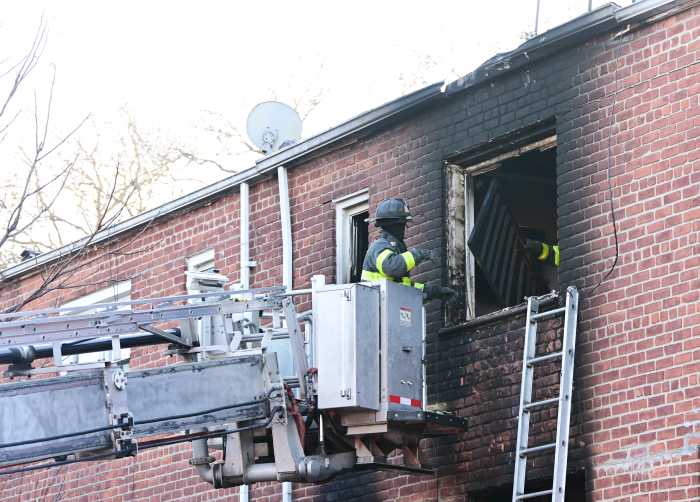
Chicago-based painter Dan Oliver merges personal memory with contemporary unease, translating moments of rupture into images rendered with surprising calm. His paintings draw on the legacies of the Chicago Imagists and twentieth-century surrealism, depicting intimate scenes of chaos—domestic interiors engulfed by flame, objects caught mid-collapse—yet executed with a serenity that belies their catastrophic content. In these meditative still-life-like narratives, destruction is witnessed only by flora, fauna, and the inanimate objects that populate each space. The work channels existential thought, imagining catastrophe not as an aberration but as an inevitable condition of being. Oliver suggests that when one fully acknowledges the impermanence of the structures we inhabit—literal and psychological—one may encounter a strange form of acceptance, even clarity.
Brooklyn-based artist Tiantian Lou approaches architectural form — not through destruction, but through softening. Working across painting and sculpture, Lou examines monumentality as a language of permanence, authority, and order. Her stacked panel paintings compress architectural geometries into carefully balanced compositions, where forms hover between building and object. Symmetries shift, edges slip slightly out of alignment, and colors modulate subtly, creating a pervasive sense of precarity. The result is a destabilized architecture—one that reveals its own vulnerability beneath the veneer of rigid geometry.
This inquiry extends into Lou’s fabric sculptures, in which columns and other structural archetypes are reimagined in cloth. By sewing, folding, and layering, she introduces a distinctly human touch to these historically authoritative forms. What begins as a measured plan evolves into an object shaped by softness, distortion, and the small decisions of the hand. As these works scale upward, their vulnerability becomes more pronounced, transforming the monument from a symbol of permanence into a site of intimate instability.
Together, Oliver and Lou offer two approaches to the architecture of uncertainty. Oliver’s practice unbuilds: the home burns, structures fail, and existential truth emerges in the glow of destruction. Lou’s practice rebuilds: she dismantles assumptions of rigidity and permanence, revealing the pliability and human contingency embedded in the forms that surround us. One charts the moment when a structure gives way; the other lingers in the liminal space where structure softens, shifts, or reconstitutes itself.
In dialogue, their work asks what it means to inhabit spaces—physical or emotional—that are never as stable as they appear. Both artists lay bare the quiet negotiations between order and upheaval, monument and ruin, certainty and its inevitable unraveling.